

Mold in air ducts in Iowa City, IA

One request and the search for a pro is handled.

Hand off the search

Can mold actually grow in my air ducts?

You keep catching a musty smell when the furnace or AC kicks on, or you spotted dark spots around a vent cover and now you're wondering if that's actually mold growing inside the ductwork itself, not just dust.

Yes, if moisture gets into the ducts

Mold needs moisture, and that's what mold growth in ducts comes down to. It can't take hold on dry metal or dry duct board. Standing water from a cracked drain pan, condensation on ducts running through a damp crawlspace, or humid summer air meeting a cold supply duct all give mold what it needs. Johnson County summers get sticky enough that moisture collecting on and inside ducts isn't unusual, especially if the system was already prone to condensation. Once mold has a foothold, running the furnace or AC pushes spores through the vents and into the rooms you breathe in. A musty smell when the system kicks on, or visible spots near a vent cover, usually means there's moisture somewhere in the line that needs to be found before cleaning does any good.

An empty unfinished basement with concrete floor and walls, exposed wood joists, steel beams and support posts, galvanized ductwork and pipes, and a single bare bulb light.

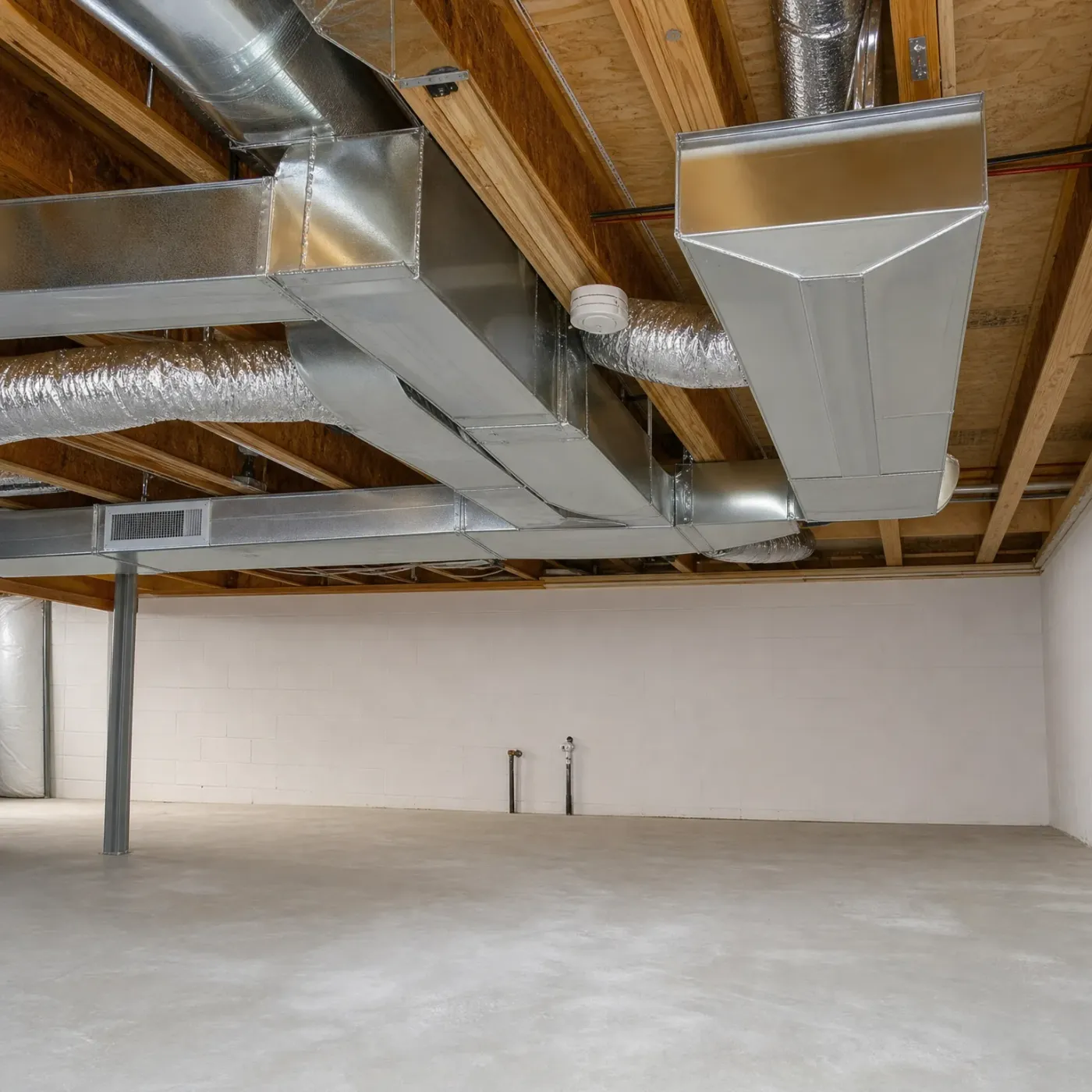
Clean and dry ductwork

This is what you want under the floor joists: bare metal trunk lines and flex duct, dry wood, no staining. Air moves through without picking up anything extra. In a Johnson County basement with the furnace and AC sharing the same ducts year-round, this is the condition that keeps both running the way they're supposed to.


Empty basement with bare concrete walls and floor, with galvanized sheet-metal HVAC ducts, a round duct elbow, and pipes running along the wooden joists of the ceiling.

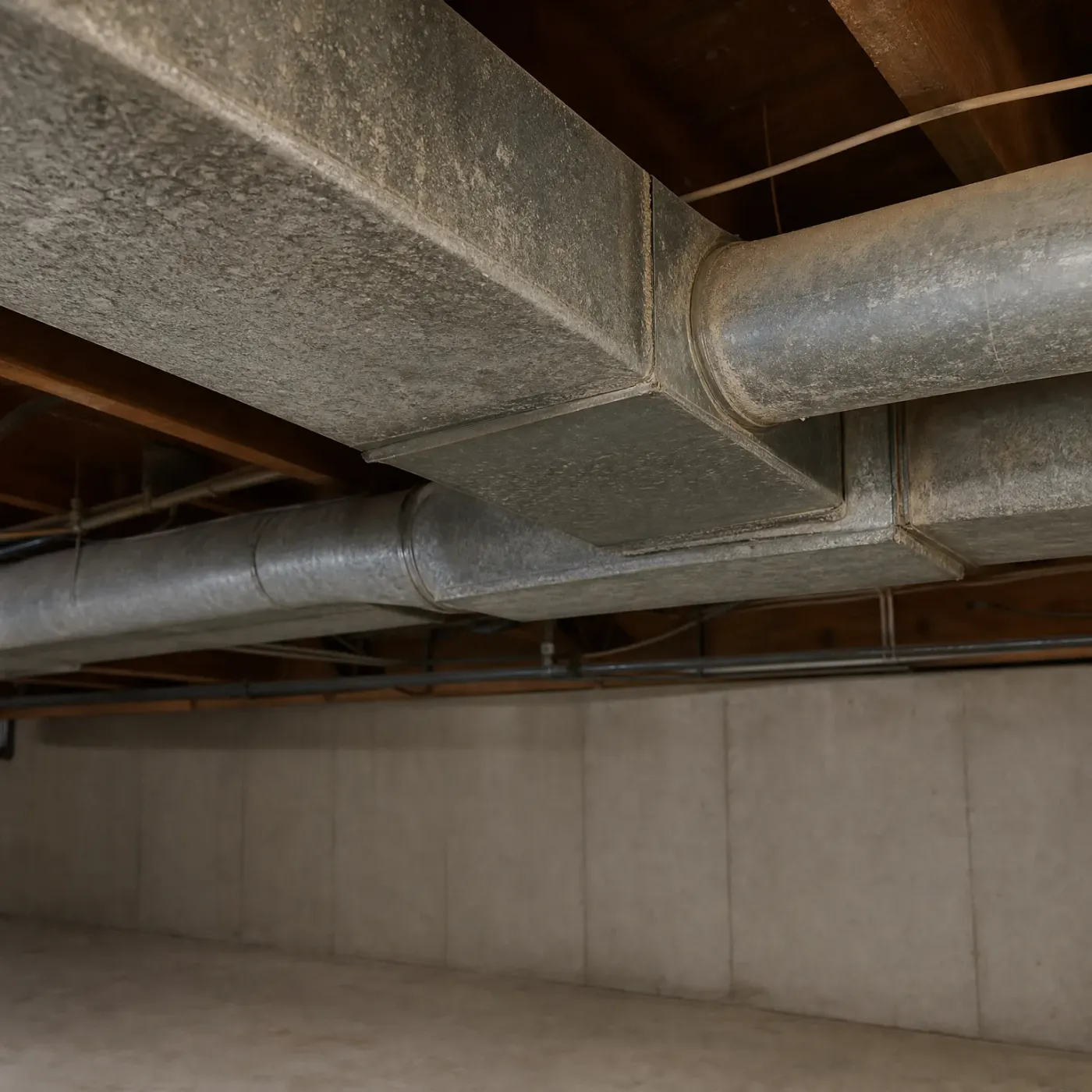
Ductwork with mold growth

Dark staining on the joists and on the duct surfaces itself means moisture has been sitting there a while, not just passing through. Once mold takes hold on wood or sheet metal next to a duct, every cycle of the furnace or AC pushes that air through the house. It doesn't clear up on its own.

A smiling man in a green long-sleeve shirt stands at a dark kitchen counter with a ceramic mug, with wood cabinets, white tile backsplash, and a window and dining table behind him.
A smiling man with wavy dark hair and a beard, wearing a navy sweater, sits at a kitchen counter with a gray mug, with a dining table, potted plant and windows behind him.
A bearded man in a dark green sweater smiles and looks to his right while seated at a white kitchen counter with a gray mug, with windows and greenery behind him.
A smiling man in a dark navy sweater stands in a home interior beside a counter with a white mug, with a kitchen, hallway and potted plant in the background.

Mold doesn't settle into ductwork at random. It needs water, and the usual source is the cooling coil, which stays wet for a while after the AC cycles off. That water is supposed to run down into the drain pan and out the condensate line. Where it causes trouble is when the duct connections near the air handler aren't sealed tight, so damp air sits in that section instead of moving through with the rest of the airflow. Bare sheet metal trunk lines resist this on their own, but the dust that collects inside them over time gives mold something to feed on once it's wet. Flex duct holds onto that moisture more easily because of the ridges in its inner liner. Runs through a crawlspace or a damp basement add another way in, since the duct can sweat on the outside and let moisture reach a seam. That's also why the smell tends to come and go rather than stay constant. It's usually one damp section, not the whole system.

Where the moisture actually starts

  • Mold needs moisture first, and in a duct system that usually means a cooling coil that stays wet after the AC shuts off.
  • Condensation on that coil drips into the drain pan, but if the duct near the air handler is leaky or poorly sealed, humid air lingers there instead of moving on.
  • Sheet metal trunk lines don't feed mold much on their own, but the dust layered inside them holds enough organic material once it's damp.
  • Flex duct is worse for this because the inner liner has ridges that trap moisture and dust in a way smooth metal doesn't.
  • A duct that runs through an unconditioned crawlspace or a humid basement can sweat on the outside, and that moisture can work its way to a seam or a loose joint.
  • Mold in the ductwork usually traces back to one wet spot, not the whole system, which is why a musty smell can come and go with the weather.
A smiling man with short dark curly hair and stubble, wearing a navy T-shirt, sits on a beige sofa looking down toward a dark object in the foreground, with a living room, round mirror, lamp and bright window behind him.
A bearded man in a red and dark plaid flannel shirt looks out a frost-edged window at a snow-covered yard, with a gray mug on the sill in the foreground.

Why does duct mold risk vary so much house to house here?

  • Half the homes here were built by 1992

    Half the ductwork in Johnson County dates to 1992 or earlier, and older runs are more likely to have loose seams where humid air gets in.

  • Heat runs October through May

    Furnaces run here from October through May, which means the air handler and its ducts sit idle and often damp for long stretches between cycles.

  • Cooling runs June through August

    AC runs June through August, and that's when the cooling coil stays wet and ductwork nearby picks up the moisture mold needs to take hold.

ACS 2020-2024 · NOAA nClimDiv 1991-2020

Galvanized rectangular and round sheet-metal ductwork running beneath a wood-joist ceiling in a basement with concrete walls and floor, with pipes and wiring alongside.
Before you get your ductwork cleaning
Empty basement with bare concrete floor, painted block walls, and an exposed wood-joist ceiling with sheet-metal and insulated flexible ductwork and a steel support column.
After you get your ductwork cleaning

Stop chasing a duct system pro

The pro who gets in touch is licensed in Iowa and works in Johnson County.

No fee to send it, and nothing to sign.

Galvanized sheet-metal HVAC ducts running along wooden joists at a basement ceiling, next to a plain off-white wall.

Why the coil matters most

A cooling coil pulls moisture out of the air every time the AC runs, and that water has to go somewhere. It drips into a drain pan and out a condensate line. If the duct connection right at the air handler isn't sealed tight, the humid air around that wet coil gets pulled into the duct run instead of just the pan, and it settles on the metal or the inside of the flex duct.

Unfinished basement interior with galvanized sheet-metal HVAC ductwork and round pipes running along a wooden joist ceiling, a furnace and water heater at the far end, and a blank white wall filling the left half of the frame.

What a sealed system does

A duct system that's sealed tight keeps that coil moisture where it belongs, in the pan and down the drain line. No gaps for humid air to escape into the trunk lines. The furnace or AC blower still moves plenty of air through the house, but it isn't pulling damp air past loose seams on the way. That's the difference between a duct system that stays dry and one that grows something.

Power here costs 13.00 cents per kilowatt-hour

At 13 cents a kilowatt-hour, running the blower longer to push air through moldy ducts doesn't hit your bill that hard, so cost isn't what should decide whether you clean them. The real question is what that air is carrying through your house every time the system runs.

EIA-861 2025

A dim room corner with a dark grey sofa and cushion, a wooden side table holding a ceramic vase and a small potted plant, a linen curtain beside a bright window, and a wall vent near the ceiling.

It's a Saturday afternoon in April and the sun through the living room window is showing you something you'd rather not see. The ceiling vent grille has a soft gray fuzz of dust along its slats, thick enough that it's started to drift down onto the bookshelf below. You run a finger along the top of a picture frame and it comes away gray. The furnace hasn't run in days, but every time the AC clicked on this week, that smell came with it, the same one you noticed last fall. You stand there a second, looking up at the grille, wondering how long that's been building up there and what else is moving through the room every time the air kicks on.

What are you actually noticing right now

You walk past a vent and catch it, that damp basement smell, stronger right when the blower kicks on and fading after a few minutes. Maybe someone in the house has started sneezing more at home than anywhere else, or a cough that clears up when you're away for a few days and comes back the night you're home. Check the supply vents in rooms you don't use much, bedrooms with the door shut, a basement office. Dark specks around the grille, a ring of staining on the ceiling or wall just past the vent cover. None of this is cause to panic, but it is the kind of thing that gets worse quietly if nobody looks at it, since whatever is growing in there keeps getting fed air and moisture every time the system runs.

Empty unfinished basement with concrete walls and floor, exposed wood joists, metal HVAC ducts and pipes overhead, and a steel support column near a framed wall.
Metal runs dry, joists clean, no streaking where the duct meets the air handler.
Empty basement with bare concrete walls and floor, a steel support column, and galvanized sheet-metal ductwork and pipes running along the exposed wood joist ceiling.
Same layout, but dark staining spreads along the seams where damp air has been escaping for a while.
  1. A camera first confirms mold is actually inside the duct runs.

  2. Vents and registers get sealed off so spores can't spread through the house.

  3. A negative air machine pulls the whole duct system under vacuum.

  4. Agitation tools knock mold and debris loose from the metal and flex duct.

A musty smell at the vent, dark spots around the register, staining where the duct meets the air handler: these point to moisture sitting somewhere in the system, usually around that cooling coil, and moisture plus dust is what mold needs. A camera confirms it one way or the other before anyone touches the ductwork. If it's there, sealing the vents, pulling the system under vacuum, and agitating the runs clears it out. Johnson County has plenty of ductwork old enough to have loose seams, and a contractor who works on these systems every summer and winter knows where those seams tend to give out and what a coil that's been running damp looks like. You'll be matched with one licensed local contractor for this, not a handful of companies calling you back at once. From there it's a question of getting someone out to look and confirm what's actually in those ducts.

Dimly lit basement or utility room interior with exposed sheet-metal rectangular ducts, round spiral ducts and pipes running beneath a wood-joist ceiling above a plain concrete wall.

Send one request and you're done looking

A licensed pro who works in Johnson County gets your request.

Duct and vent cleaningDucts or ventsJohnson County, IA
Step 1 of 2

What ZIP code is the job in?